全球电子发票地图:主要地区、国家路线与企业落地差异
有的国家先让发票经过税务机关授权,有的通过 Peppol 等网络在企业间交换,还有的要求把发票数据报送税务机关。把它们放在同一张全球地图上,能看出电子发票并不是一套规则、一个平台或一条统一时间表。
跨国企业常说“我们已经部署电子发票”,但这句话可能指向完全不同的事:可以开具结构化文件、可以接入某个业务网络、能把发票先交税务机关审核、能把交易数据实时或定期报送,或者只是把 PDF 放到供应商门户。国家比较的关键不在于给每个国家贴一个“有/没有电子发票”标签,而在于分别核对对象范围、文件规则、交换路径、税务数据路径和生效时间。
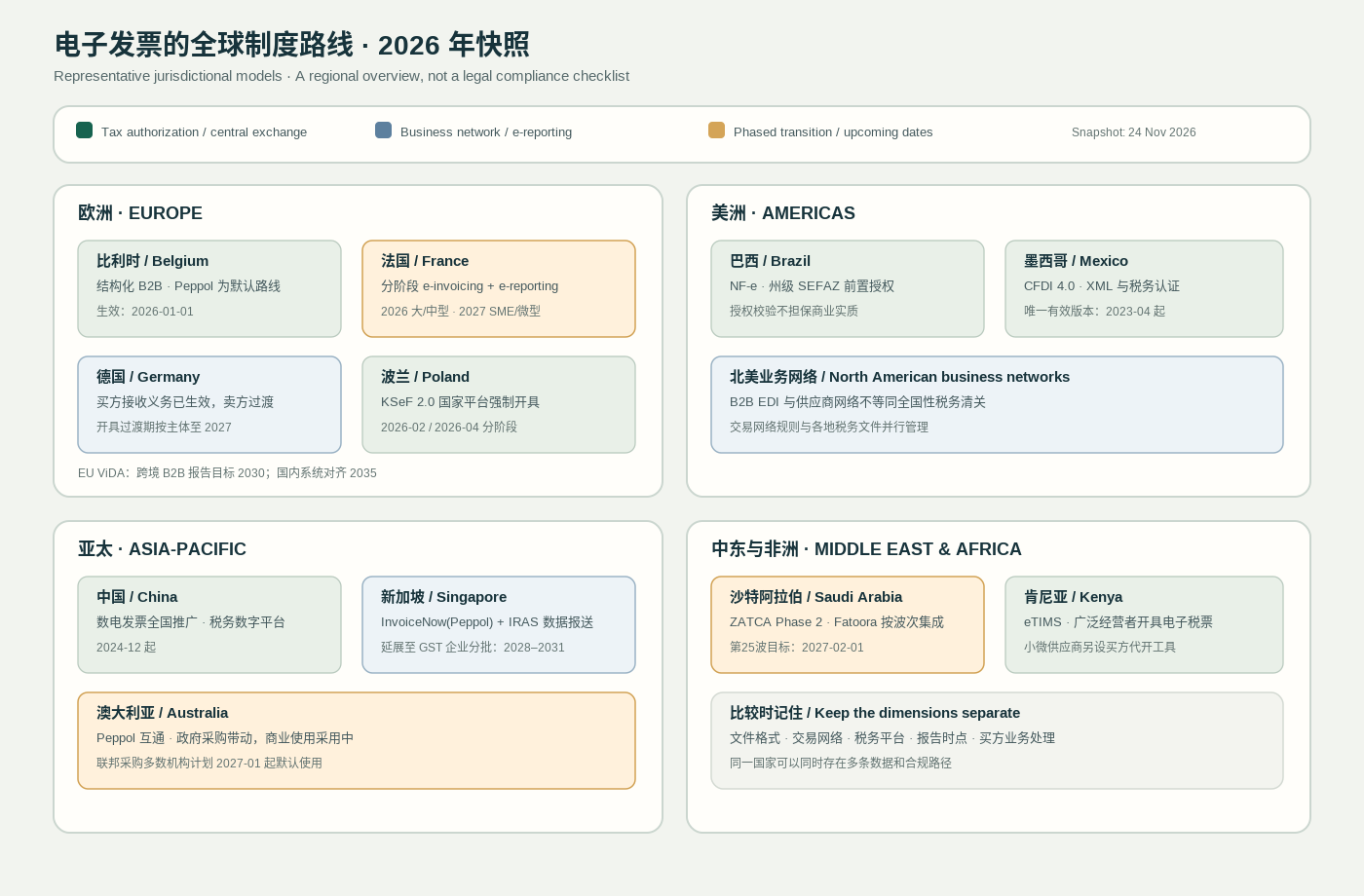
一、先看全球分布:五种并行路线
| 路线 | 核心问题 | 常见机制与地区样本 |
|---|---|---|
| 税务授权/清关 | 发票在交付买方或货物放行前,是否需要税务平台确认? | 巴西 NF-e、墨西哥 CFDI、意大利 SdI 等国家体系有各自的电子签名、校验、授权或交付流程。 |
| 税务平台集中交换 | 平台是否既接收发票,又检查并将其交给收件人? | 意大利 SdI、中国税务数字平台等体现不同程度的集中式管理;平台权限、数据流和适用交易并不相同。 |
| 互联网络交换 | 企业如何以共通格式寻址并向交易对方送达? | Peppol 网络在比利时、澳大利亚、新加坡等地用作交换基础;国家也可把本地税务报告叠加其上。 |
| 持续交易数据报告 | 税务机关何时收到哪些销售、采购或支付字段? | 法国 e-reporting 与新加坡 GST InvoiceNow 把报送义务与业务网络或数据传输连接起来;范围和频次由本地制度规定。 |
| 制度过渡/多轨并行 | 是否允许旧格式、纸面流程或替代渠道在过渡期继续使用? | 德国、法国、波兰等实施安排有分期和过渡;企业需要管理例外、阈值、退补和迁移日期。 |
这些路线可以组合,不能简单归为互斥的国家阵营。例如,商业发票可能通过 Peppol 到达买方,销售数据另按当地规则传给税务机关;也可能由集中式税务平台先授权发票并承担转发。对发票格式的合规、技术送达、税务申报和买方审批要分别核验。
二、欧洲:共同语义方向下,各国仍有不同时间表
欧盟的共同标准和 ViDA(VAT in the Digital Age)为区域互操作和跨境数字报告设定方向,但在 2026 年,它不等于所有成员国已采用同一个中央清关平台。成员国保有各自的国内制度;既有国内实时报告系统有延续和对齐安排。
比利时:2026 年起,范围内 VAT 企业 B2B 使用结构化发票
比利时官方说明,2026 年 1 月 1 日起,几乎所有比利时 VAT 纳税企业之间、属于义务范围的交易须使用结构化电子发票;B2C 私人消费发票不在同一强制范围内。Peppol 网络和 Peppol BIS 是默认交换方式/参考格式,符合欧标的替代格式在双方同意时可能适用。客户单方要求只通过其私有门户提交,不能当然取代法定结构化发票义务。对于出口、豁免或其他例外,需按官方 FAQ 和实际身份判断。
法国:2026 年先接收和大型企业开具,2027 年扩至中小企业
法国税务部门公布的时间表自 2026 年 9 月 1 日起实施第一阶段:所有规模企业在供应商负有开具义务时须能接收电子发票;大型企业和中型企业同时开始开具电子发票,并向政府电子传递交易和支付数据。2027 年 9 月 1 日,开具及相关交易/付款数据传递扩展到中小与微型企业。法国把 e-invoicing 和 e-reporting 分开设计:跨境或 B2C 等不以同样方式开具电子发票的交易,可能仍要报送数据。
德国:接收义务已经开始,开具义务仍处过渡窗口
德国自 2025 年 1 月 1 日起,国内 B2B 买方须能接收符合规则的电子发票。卖方开具方面,2025—2026 年可按过渡条款继续用纸面或经收件方同意的其他格式;上一年度营业额不超过 80 万欧元的卖方过渡期延至 2027 年底,特定 EDI 流程也有至 2027 年底的过渡安排。因此,截至本文日期,“德国所有企业必须已只开结构化发票”是不准确的。团队应分开处理收票准备和开票时间表。
波兰:KSeF 2.0 分规模启动,报送入口是国家平台
波兰官方公布的 KSeF 强制开具安排于 2026 年 2 月 1 日先覆盖 2024 年销售额含 VAT 超过 2 亿兹罗提的纳税人,2026 年 4 月 1 日扩展到其他纳税人。按月开具发票总额不超过 10,000 兹罗提的小规模纳税人,2026 年底前有暂缓开具义务的规定。接收端的 KSeF 发票接收义务较早开始;并存在特定排除、离线和过渡安排。跨国集团不能只按供应商规模作一次性判断,还要核对 NIP 身份、文档类型、离线方式及当期官方规则。
意大利与欧盟下一阶段:成熟的 SdI 和更远期的 ViDA
意大利对境内多类 B2B 与 B2C 发票的电子传输长期通过税务局管理的 Sistema di Interscambio(SdI)进行,文件格式、特定主体豁免和跨境交易处理仍以本国法和税务局指导为准。向前看,欧盟 ViDA 已通过:跨境 B2B 交易的数字报告要求计划从 2030 年 7 月 1 日起适用;拥有国内数字实时交易报告制度的成员国须在 2035 年 1 月前将其与欧盟框架对齐。这是未来节点,不应提前写成 2026 年企业的统一义务。
三、美洲:拉丁美洲多见税务授权,美国式商业交换仍然多轨
巴西:NF-e 先进行授权,授权不等于税务机关认可交易实质
巴西的 NF-e 是带数字签名的税务电子文件;典型流程是企业把发票信息发给有管辖权的州财政部门(SEFAZ)或授权环境,取得 Autorização de Uso 后,才可按规则凭辅助文件开展相应货物流转。每张票的自动授权校验强调身份、完整性、格式和发行资格等前置条件;它并不替卖方担保交易的商业真实性。巴西同时有商品发票、服务发票等不同电子文件体系,实施需按交易类型和地方权限区分。
墨西哥:CFDI 4.0 与数字印章/认证链
墨西哥税务局 SAT 把 CFDI 4.0 列为 2023 年 4 月 1 日起的唯一有效版本。开票需按规范提供接收方 RFC、名称、税制和税务地址等信息,生成 XML 文件并完成相应的签章/认证流程。系统改造的重点不仅是传输接口,还包括主数据:买方名称、邮编和税务属性的差异会直接导致认证失败或拒收。CFDI 的税务认证机制与 Peppol 四角网络是两种不同架构。
北美企业仍常把“电子发票”当作 ERP 到客户的 B2B 自动化流程;美国各联邦、州和私营网络并非一个统一的全国增值税发票清关平台。跨境企业应把商业 EDI/网络要求与墨西哥等国的税务发票认证义务拆开管理。
四、亚太:税务平台、业务网络与政府采购可并行
中国:数电发票自 2024 年 12 月在全国正式推广
国家税务总局公告明确自 2024 年 12 月 1 日起在全国正式推广应用全面数字化电子发票(数电发票)。数电发票以数字形式存在、统一编号,相关信息可通过税务数字账户和电子发票服务平台在征纳主体间流转;公告说明其与纸质发票具有同等法律效力,平台向纳税人提供开具、用票等服务。对于跨国企业,这一体系的关键是接入中国税务服务、数电发票的数据要素、用途确认和红字更正流程,而不是套用另一国的 Peppol 或 CII 字段映射。
新加坡:InvoiceNow 网络上的交换与 IRAS 数据报送相连
新加坡 InvoiceNow 是以 Peppol 标准为基础的全国电子发票网络。GST InvoiceNow Requirement 要求符合条件的注册企业使用可连接的解决方案,将发票数据传给 IRAS。首阶段从 2025 年 11 月的新设公司自愿 GST 注册者开始;2026 年 4 月起适用于所有新申请自愿 GST 注册的企业;其余 GST 注册企业计划从 2028 至 2031 年分阶段纳入。这里的要点是“网络交换”和“向税务机关交付数据”被制度串联,但两者仍是不同功能。IRAS 的范围、豁免及阶段表应以实时更新的官方页面为准。
澳大利亚:Peppol 促进互通,政府采购带动采用
澳大利亚税务局 ATO 作为 Australian Peppol Authority,制定本地使用要求并认证服务商;发票通过 Peppol 网络在企业软件间结构化交换,ATO 不因此自动收到商业发票副本。到 2026 年,联邦非企业制机构按计划提高收票比例并启用发送能力;澳大利亚政府计划从 2027 年 1 月起,在多数联邦采购中把 eInvoicing 作为默认开票方式。该路线更强调业务网络互通与政府采购带动,不应误读为所有企业向 ATO 实时报送每张发票的全国性清关义务。
五、中东与非洲:分批接入和广泛的电子税务凭证
沙特阿拉伯:ZATCA 的第二阶段按波次通知接入
沙特 ZATCA 第一阶段要求纳税人生成并保存电子税务发票;第二阶段再要求被选中的纳税人把兼容方案接入 Fatoora 平台、按指定格式开票并包含所需字段。第二阶段按波次推进。ZATCA 于 2026 年 7 月公布第 25 波:2022—2025 任一年度 VAT 应税收入超过 187,500 里亚尔的纳税人,将被通知在 2027 年 2 月 1 日前完成集成。企业应以收到的 ZATCA 通知为准,不能只用全国统一的单一截止日期。
肯尼亚:eTIMS 覆盖广泛经营者,侧重税务发票管理
肯尼亚税务局 KRA 说明,所有从事经营活动的人员原则上须接入 eTIMS 并开具电子税务发票;年营业额不超过 500 万肯尼亚先令的小企业供应,买方可使用买方代开工具。eTIMS 的覆盖面与供应链 B2B 网络目标不同,它主要是一项广泛的税务发票电子化要求,不能仅凭“电子”二字推断其文件语义、传输和跨境互通方式与 Peppol 相同。
六、从国家概况转成企业合规矩阵
全球国家清单更新频繁,企业内部需要的不是一张“已/未实施”地图,而是可维护的国家规则台账。每个经营实体至少记录以下字段,并让税务、财务、采购、IT 与当地服务商共同确认:
| 台账字段 | 需要记录的判断 | 常见漏项 |
|---|---|---|
| 实体与交易范围 | 卖方/买方的本地登记身份;B2B、B2G、B2C;境内、跨境;商品或服务 | 把集团注册地当作每张票的法定开票地;混淆法人和分支机构 |
| 文件与规则版本 | 结构化格式、数据模型、当地字段、代码表、数字签名或 QR 要求 | 买方可读 PDF 被误当成法定原始电子文件;版本升级无回归测试 |
| 交换和报送 | 税务平台/授权、Peppol/服务商、API、EDI、门户;谁向税局交付什么数据 | 把商业送达回执当作税务批准;把网络注册误作完成税务报送 |
| 时点与状态 | 开票、发送、税务受理、买方拒收、会计入账、付款、补报和更正时限 | 只存一个“成功”状态,不知道是哪个系统成功 |
| 例外和韧性 | 阈值、豁免、离线/故障流程、迟发、境外买方、应急编号和补传 | 过渡条款、红字/贷项、断网后补报、逐波次通知没有进入日历 |
建议把即将到来的法定日期与技术启用日期分开管理:前者决定何时必须遵守,后者还需考虑身份和证书注册、数据主档修复、服务商配置、财务审批和交易伙伴测试。按“国家规则包+共用内部模型+本地连接器”组织系统,通常比在 ERP 主流程中硬编码国家特例更容易维护。供应商评估应包括国家覆盖矩阵、官方认证状态、原始数据可导出性、版本更新周期、离线处理、责任边界和退出迁移能力。
- 欧盟委员会:VAT in the Digital Age (ViDA) 进度和时间表。
- 法国税务局:电子发票改革适用时间表。
- 比利时官方电子发票网站:B2B 义务 FAQ。
- 德国联邦财政部:强制电子发票常见问题与过渡规定。
- 波兰财政部:KSeF 2.0 义务范围与日期。
- 意大利税务局:电子发票与 SdI 操作说明。
- 巴西 NF-e 全国门户:NF-e 运作流程;墨西哥 SAT:CFDI 格式和 4.0 版本说明。
- 中国国家税务总局:全国推广应用数电发票公告。
- 新加坡 IRAS:GST InvoiceNow 适用范围和分阶段日期;澳大利亚 ATO:政府采购电子发票采用进度。
- 沙特 ZATCA:第二阶段第 25 波通知;肯尼亚 KRA:eTIMS 经营者范围。
范围说明:本文选择制度差异明显的国家作为样本,不是全球穷尽清单。官方网页、法规和实施通知可能更新,系统上线与过渡期还会受企业身份、收入阈值、交易类型和例外条款影响。实施前应重新核对当地税务机关和采购方的现行要求。本文仅供信息参考,不构成法律、税务或系统实施意见。
The Global E-Invoicing Map: National Models, Rollouts and Business Impact
Some jurisdictions clear invoices through tax platforms; others exchange them over networks such as Peppol, while also requiring tax-data submissions. The result is not one global rulebook, platform or timeline.
When a multinational says it has “implemented e-invoicing,” that may mean it can create structured files, connect to a business network, submit invoices for tax authorisation, report transaction data continuously, or upload PDFs to a buyer portal. A useful country comparison separates scope, document rules, delivery route, tax-data path and effective date.
1. Five routes are developing in parallel
| Route | Main question | Examples |
|---|---|---|
| Tax authorisation or clearance | Must the tax platform approve an invoice before delivery or movement of goods? | Brazil NF-e, Mexico CFDI and Italy’s SdI have jurisdiction-specific validation, authorisation or delivery flows. |
| Central tax-platform exchange | Does a public platform both receive invoices and check or forward them? | Italy’s SdI and China’s digital tax platform illustrate different centralised arrangements. |
| Interoperable business network | How can businesses address each other and deliver structured invoices? | Peppol supports exchange in Belgium, Australia and Singapore; local reporting duties may be layered on top. |
| Continuous transaction reporting | When must tax authorities receive which sales, purchase or payment data? | France’s e-reporting and Singapore’s GST InvoiceNow connect reporting to local systems and rules. |
| Transition and parallel routes | Can legacy, paper or alternative channels continue temporarily? | Germany, France and Poland have phased or transitional arrangements. |
These models can coexist. A business may deliver a commercial invoice over Peppol and report data separately to the tax authority; a central platform may authorise and forward invoices. Document compliance, technical delivery, tax reporting and buyer approval must be tested separately.
2. Europe: shared standards, different national calendars
The EU’s common standards and VAT in the Digital Age (ViDA) point toward interoperability and cross-border digital reporting. As of 2026, however, ViDA is not a single EU-wide clearance platform. Member States retain domestic arrangements, with transition and alignment rules for existing real-time reporting systems.
Belgium: structured B2B invoicing is in force from 1 January 2026
Belgium’s official guidance says nearly all in-scope transactions between Belgian VAT-registered businesses require structured e-invoices from 1 January 2026. The same obligation does not apply to ordinary B2C private-consumer invoices. Peppol is the default exchange route and Peppol BIS the reference format; an alternative format compliant with the European standard may be agreed by both parties. A private buyer portal does not automatically replace the statutory invoice route. Check the official exceptions for the specific entity and transaction.
France: first phase started in September 2026
From 1 September 2026, all businesses must be able to receive electronic invoices when suppliers are required to issue them. Large and intermediate-sized companies must also issue e-invoices and electronically transmit transaction and payment data to the administration. From 1 September 2027, issuance and related data-transmission obligations extend to SMEs and micro-businesses. France distinguishes e-invoicing from e-reporting, so some cross-border or B2C transactions may require data reporting even when they do not follow the same invoice exchange route.
Germany: receipt is required; issuance is still in a transition window
German domestic B2B buyers have had to be able to receive e-invoices since 1 January 2025. Issuers can use transitional alternatives through 2026. For sellers with prior-year turnover of no more than €800,000, the transition extends through 2027; certain EDI processes also have a transition through the end of 2027. It is therefore inaccurate, as of this article’s date, to say every German business must already issue only structured e-invoices. Track receiving readiness separately from each seller’s issuance deadline.
Poland: KSeF 2.0 begins by turnover band
Poland’s tax administration set mandatory KSeF issuance from 1 February 2026 for taxpayers whose 2024 sales including VAT exceeded PLN 200 million, and from 1 April 2026 for other taxpayers. Small taxpayers whose monthly invoice value does not exceed PLN 10,000 have a temporary issuance deferral through the end of 2026. Receipt obligations began earlier, with statutory exclusions and offline/transition provisions. Multinationals need to check the taxpayer’s Polish identifier, document type, offline process and current rules rather than applying a single group-wide cut-off.
Italy and the next EU phase: established SdI, future ViDA
Italy has long required many domestic B2B and B2C invoices to be transmitted through the tax administration’s Sistema di Interscambio (SdI). File rules, exemptions and cross-border treatment remain matters of Italian law and tax guidance. Looking ahead, ViDA was adopted: digital reporting requirements for cross-border B2B transactions are scheduled from 1 July 2030; Member States with domestic real-time transaction reporting must align with the EU framework by 1 January 2035. These are future milestones, not a uniform 2026 business obligation.
3. The Americas: tax-authorisation systems in Latin America
Brazil: NF-e authorisation is a prerequisite, not a warranty of the transaction
Brazil’s NF-e is a digitally signed tax document. In the typical flow, the issuer sends invoice data to the competent state treasury authority (SEFAZ) or an authorised environment and obtains an Autorização de Uso before the relevant goods movement can proceed under the applicable rules. Per-invoice checks focus on identity, integrity, format and issuer authority; they do not certify the commercial substance of the underlying transaction. Brazil also has different electronic document systems for goods, services and other activities, so local and transaction scope matters.
Mexico: CFDI 4.0 and a tax-stamping chain
Mexico’s SAT lists CFDI 4.0 as the only valid version from 1 April 2023. The issuer must use the prescribed recipient RFC, name, tax regime and fiscal address fields, generate the XML and complete the required signing/certification process. Master data matters: a mismatch in the buyer’s registered name, postcode or tax attributes can cause rejection. CFDI certification is a different architecture from Peppol’s four-corner business exchange.
Across North America, businesses also use ERP-to-customer networks and commercial EDI processes. These do not form one national VAT clearance platform in the United States. Cross-border companies should manage the commercial network requirements separately from tax-invoice certification duties in countries such as Mexico.
4. Asia-Pacific: tax platforms, business networks and procurement can coexist
China: nationwide promotion of fully digitalized invoices began in December 2024
The State Taxation Administration’s announcement took effect on 1 December 2024 and promoted fully digitalized electronic invoices nationwide. The invoices exist digitally, use unified numbering and can flow between taxpayers and tax authorities through digital tax accounts and the electronic invoice service platform. The announcement gives them the same legal effect as paper invoices and describes platform services for issuance and use. For global companies, the practical work includes Chinese tax-platform access, local data elements, purpose confirmation and red-letter correction processes; it is not simply a mapping exercise to another country’s Peppol or CII format.
Singapore: InvoiceNow exchange is connected to IRAS data reporting
InvoiceNow is Singapore’s national e-invoicing network based on Peppol. The GST InvoiceNow Requirement requires covered GST-registered businesses to use InvoiceNow-ready solutions to transmit invoice data to IRAS. The first phase began in November 2025 for newly incorporated voluntary GST registrants; from April 2026 it covers all businesses applying for new voluntary GST registration. Remaining registered businesses are scheduled to enter in phases from 2028 to 2031. Network exchange and tax-data submission are connected by the regime but remain distinct functions. Check IRAS’s live page for scope, exclusions and phase updates.
Australia: Peppol supports interoperability, with procurement driving adoption
The Australian Taxation Office is the Australian Peppol Authority, defining local requirements and accrediting providers. Invoices are exchanged in structured form through Peppol, and the ATO does not automatically receive a copy of every commercial invoice. During 2026, non-corporate Commonwealth entities are increasing e-invoice reception and enabling sending. From January 2027, the Australian Government plans to make eInvoicing the default method for most federal procurement. This is a network and procurement-led model, not a nationwide requirement for every business invoice to be cleared by the ATO.
5. The Middle East and Africa: phased onboarding and broad digital tax invoices
Saudi Arabia: ZATCA Phase 2 integrates selected taxpayers in waves
Saudi Arabia’s Phase 1 requires taxpayers to generate and store electronic tax invoices. Phase 2 requires selected taxpayers to integrate compatible systems with the Fatoora platform, use the prescribed format and include required fields. The rollout is wave-based. In July 2026 ZATCA announced Wave 25: taxpayers whose VAT-taxable revenue exceeded SAR 187,500 in any year from 2022 to 2025 will be notified to integrate by 1 February 2027. A taxpayer should follow its own ZATCA notice, not assume one nationwide integration date applies to everyone.
Kenya: eTIMS covers businesses broadly and focuses on tax invoices
The Kenya Revenue Authority says persons engaged in business generally need to onboard eTIMS and issue electronic tax invoices. For supplies from small businesses with annual turnover not exceeding KES 5 million, a buyer-initiated invoicing tool is available. eTIMS has a broad tax-invoice-management scope; that does not mean it uses the same document semantics, delivery topology or cross-border interoperability model as Peppol.
6. Turn the country map into an operating matrix
A static “implemented/not implemented” map is not enough for enterprise compliance. Maintain a country rule register with tax, finance, procurement, IT and local providers. For each legal entity, record:
| Register field | Questions to resolve | Frequent gap |
|---|---|---|
| Entity and transaction scope | Local seller/buyer status; B2B, B2G or B2C; domestic or cross-border; goods or services | Assuming group headquarters determines the legal issuer; confusing a branch with a separate entity |
| Document and rule version | Structured syntax, data model, local fields, code lists, signature or QR requirements | Treating a readable PDF as the legally required original; no regression test for upgrades |
| Exchange and reporting | Tax platform/clearance, Peppol/provider, API, EDI or portal; data and destination for tax reporting | Confusing a delivery receipt with tax approval, or network registration with filing |
| Timing and statuses | Issuance, delivery, tax acceptance, buyer rejection, posting, payment, correction and recovery deadlines | One generic “success” status that hides which system responded |
| Exceptions and resilience | Thresholds, exemptions, offline/failure flow, late filing, foreign buyers, contingency IDs and replay | Transition rules, credit notes, outage recovery or wave notices missing from the calendar |
Manage the legal effective date separately from the technical go-live date. The latter also depends on registrations, certificates, master-data cleanup, provider configuration, finance approvals and partner testing. A shared internal model, country rule packs and local connectors are generally easier to maintain than hard-coding each exception in the ERP’s core. Vendor review should cover country/version coverage, official accreditation, original-data export, update cycles, offline operations, responsibility boundaries and exit migration.
- European Commission: ViDA progress and timeline.
- France tax authority: e-invoicing reform dates.
- Belgium official e-invoice site: B2B mandate FAQ.
- German Federal Ministry of Finance: mandatory e-invoice FAQ and transition periods.
- Poland Ministry of Finance: KSeF 2.0 scope and dates.
- Italy Revenue Agency: SdI operating guidance.
- Brazil NF-e Portal: NF-e process; Mexico SAT: CFDI format and version 4.0.
- China State Taxation Administration: nationwide promotion of fully digitalized e-invoices.
- Singapore IRAS: GST InvoiceNow scope and phases; Australia ATO: public-procurement adoption.
- Saudi ZATCA: Phase 2 Wave 25 notice; Kenya KRA: eTIMS business scope.
Scope: This is a selection of countries chosen to illustrate differences, not an exhaustive global inventory. Government pages, laws and implementation notices change, and scope can depend on legal entity, threshold, transaction type and exemptions. Recheck current requirements with the local tax authority and procurement counterpart before implementation. This article is for information only, not legal, tax or implementation advice.